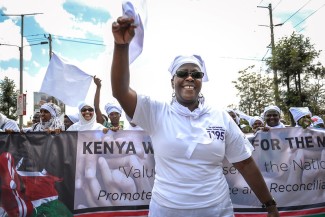
This briefing paper focuses on the topic of prosecuting international and other serious crimes in Kenya, including crimes committed in the context of the postelection crisis of late 2007 and early 2008. In particular, it identifies and analyzes obstacles and opportunities for such prosecutions within current legal and institutional frameworks.
This publication provides an overview of the essential best practices guiding the main aspects of a truth commission, answering basic questions relating to its goals, powers, operations, framework, protections for commissioners and witnesses, and reporting. Its intention is to provide practical guidelines for practitioners, commission staff, and political leaders on a wide spectrum of experiences that can be adapted to suit the unique social, political, and legal context of the state.
Based on significant field research and interviews with the Higher National de-Baathification Commission, this report focuses on Iraq’s purge of members of Saddam Hussein’s Baath Party, which is the most well-known example of large-scale and politically based dismissals in the Middle East and North Africa. The report summarizes the structure and impact of de-Baathification from 2003 to 2011. It gives unique insight into de-Baathification’s goals, framework, impact, and problems. It includes a focused look at de-Baathification in Iraq’s Ministry of Finance from 2003 to 2006 and summarizes seven key lessons for policy makers in other countries.
There is now an opportunity to design and implement a reparations program for victims of human rights and humanitarian law violations in Uganda. As with other countries emerging from conflict, the contours of a Ugandan reparations policy have been the subject of extended debate and generated high expectations. While the government has embarked on several reconstruction, recovery, humanitarian, and development programs for the north and other conflict-affected parts of the country, these programs were explicitly motivated by stabilization, development, and poverty-reduction objectives, rather than justice and reparations goals. This report examines approaches for identifying and categorizing victims, defining benefits and beneficiaries, and sequencing the delivery of reparations, offering guidance in assessing how the needs of the most vulnerable victims can be met and what long-term capacities must be put in place to implement a comprehensive reparations program.
In collaboration with the Brookings-LSE Project on Internal Displacement, ICTJ’s Research Unit examined how transitional justice can be used to address the range of injustices associated with displacement and thereby serve as part of a comprehensive approach to the resolution of displacement.Based on the project’s findings, this report provides an overview of the relationship between transitional justice and displacement and offers specific guidance to policymakers and practitioners in the numerous fields that share a concern with displacement, including transitional justice, humanitarianism, peacebuilding, and development.
This joint report by ICTJ and the Institute for Human Rights Study and Advocacy (ELSHAM-Papua) provides important insight into the ongoing debate on steps required to achieve a sustainable peace in Papua. The report reviews Papua's recent history within a transitional justice framework, and provides expert recommendations on truth seeking, justice, reparations, institutional reform, and enforcing the rights of women victims. Based on more than 100 interviews carried out in 2011 in the districts of Sorong, Manokwari, Biak, and Paniai, the report reviews Papua’s recent history, including the Special Autonomy Law governing the relationship between the Papua province and Indonesia, within a transitional justice framework.
This resource book focuses on truth commissions mandated to look at a period of human rights violations that particularly affected indigenous communities, such as those in Guatemala, Peru, Paraguay, Canada, Cote d'Ivoire, and Nepal. It is an initial effort to systematically organize lessons learned and make further progress by designing truth processes that are fully compliant with the rights of indigenous peoples.
The conviction of Thomas Lubanga is a milestone for the international criminal justice system established by the Rome Statute, and may make an important contribution to the development and definition of the right to reparations in international human rights law. ICTJ has produced a briefing note examining the practical and legal issues surrounding the ICC's decision in regards to reparations in the Lubanga case, as well as what lessons the ICC can learn from the broader experiences of the transitional justice field.
Based on interviews with 1,200 people, this study assesses conflict victims' experience with the government's Interim Relief Program since its inception in 2008. The findings are intended to inform a future reparations policy that would seek to help those whose human rights were violated during the conflict period of 1996 to 2006.
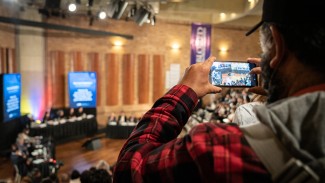
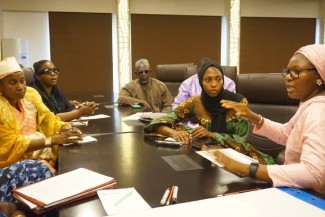
The International Center for Transitional Justice (ICTJ) and the United Nations Development Programme, with the support from the governments of Denmark and South Africa, held a retreat on Supporting Complementarity at the National Level: An Integrated Approach to the Rule of Law, at Greentree in Manhasset, New York, from December 7 through 9 in 2011. The retreat was conducted according to the Chatham House Rule, and this report provides a summary of the principal discussions without attributing views to individual participants.