After nearly 50 years of military rule ended in 2011, Myanmar has experienced rapidly evolving reforms. ICTJ provided technical assistance to civil society Myanmar in its effort to incorporate transitional justice into the reform process in order to strengthen democratic institutions and increase confidence in the peace process.
Burma/Myanmar
Image
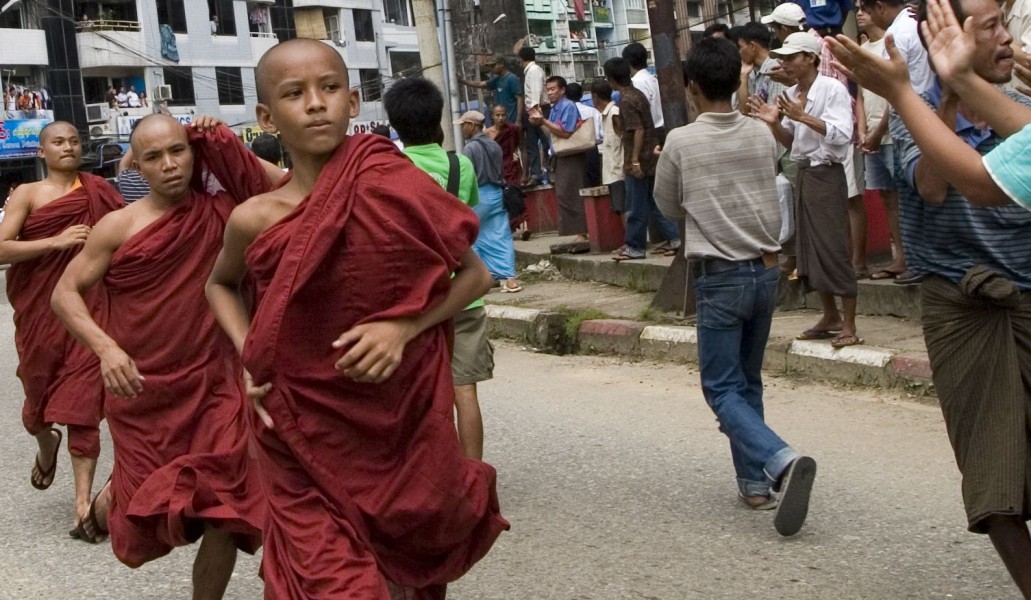
Novice Buddhist monks run to join an anti-government protest in Rangoon, Myanmar, on September 26, 2007. (Will Baxter)
Past
Background: A New Government Must Confront Painful Past
Myanmar was ruled by a series of authoritarian military governments from 1962 to 2011. Throughout this period, opposition and democracy movements have been brutally suppressed, resulting in thousands of political prisoners as well as violent crackdowns on periodic public protests, most notably in 1988 and 2007. A new 2008 constitution set the stage for the first civilian government to take power in 2011, but more work is needed to address the legacy left behind by junta rule, including the release of political prisoners and the distribution of reparations.
While the entire country has been harshly affected by military rule, political restrictions, extreme poverty and economic mismanagement, the border areas populated by ethnic minority groups have been in various states of conflict for the past decades, in some cases since before independence. The Myanmar military and ethnic armed groups have been accused of committing numerous war crimes and crimes against humanity including sexual violence, torture, extrajudicial killings, forced displacement of entire villages, recruitment and use of child soldiers, and destruction of property.
Seeking Reform in A New Political Dynamic
In 2008, the State Law and Order Restoration Council (the military junta at the time) drafted a new constitution which was passed in a referendum held weeks after Cyclone Nargis devastated much of the lower part of the country. Elections in 2010 ushered in the first civilian government of Myanmar since 1962. However, the new government was led by recently retired military officers, including President Thein Sein, and the constitution gave the military a controlling role in much of national politics.
Thein Sein’s government initiated a number of reforms, including loosening restrictions on the press and on public protest, releasing many of the estimated 2,000 political prisoners and allowing many political exiles to return. The long-isolated country was seen as opening up, and experienced a flood of international aid and investors. However, the military remained an influential actor, and many topics – including allegations of human rights violations – were strictly off the table.
One of the largest undertakings of Thein Sein’s administration was the initiation of a comprehensive peace process with the ethnic armed groups. Starting with bilateral ceasefires, which were completed with almost all of the approximately 18 major ethnic armed groups, the process moved to a Nationwide Ceasefire, which in the end was signed only by 8 of the 15 groups invited to sign.
In 2015, the next round of national elections saw the opposition party National League for Democracy (NLD), led by former political prisoner and Nobel Prize winner Aung San Suu Kyi, elected in a landslide. Though Suu Kyi is ineligible for the presidency due to her having been married to a British citizen and having British children, she was appointed State Counselor, a position specially created for her which gives her broad powers to direct many aspects of national policy.
The NLD-led government has continued the previous administration’s approach to the peace process, and held the first of a set of planned Panglong Conferences in September 2016, between government, military, ethnic armed groups and political parties to discuss political resolution to the conflicts, including federalism and demobilization/security sector reform.
Struggles to Acknowledge the Past
During the transition and the peace process, discussion of the massive human rights violations of the past has been largely understood to be off the table. Suu Kyi herself has urged the country to forget the past and move forward. At least one family member of a victim of alleged extrajudicial killing has faced defamation charges for submitting a complaint to the Myanmar National Human Rights Commission. Activists have been imprisoned for months for social media posts critical of more minor aspects of the military, such as its uniforms.
However, not all victims have remained silent about past abuses. Organizations dedicated to assisting victims and documenting human rights violations have organized unofficial truth-telling events, documentation projects, and advocacy for reparations. Former political prisoners and victims of ethnic conflict have continued to raise public awareness and seek justice under the NLD-led government.
One non-state armed group, the All-Burma Students’ Democratic Front, has also taken steps to addressing allegations of extrajudicial killings and torture by convening a Truth and Justice Committee. The committee carried out a truth-finding project that culminated in a final report, Dignity, acknowledging and detailing abuse committed by ABSDF against its own members who were alleged to be spying for the Myanmar military.
Despite the peace process, conflict continues in the ethnic areas, particularly but not exclusively northern Shan State and Kachin State. Human rights organizations continue to report conflict-related violations including killings, torture and sexual violence.
In 2016, Lieutenant General Mya Tun Oo took the unprecedented step of admitting that a group of soldiers was responsible for the deaths of five ethnic Shan men while they were being interrogated in military custody. Most of the soldiers confessed in a partially-open hearing of a military tribunal, attended by the victims’ families and their lawyers.
This is the most recent in a slow trend of cases in which local advocacy has succeeded in getting crimes committed by soldiers against the civilian population adjudicated in military, and in some rare cases civilian, courts. However, the decision to allow trials to be held in civilian courts remains under the authority of the Commander in Chief of the military, and the few cases that are reported are rarely brought to trial.
ICTJ's Role
ICTJ has pushed for Myanmar to provide redress to political prisoners. It has also bolstered civil society efforts to bring victim experiences into the national dialogue.
Victim Support: ICTJ worked with civil society organizations to plan community events where victims could speak publicly about their experiences. It also produced manuals and other training resources on how to document and evaluate abuse claims with civil society organizations, including the Network for Human Rights Documentation-Burma (ND-Burma).
Reparations: ICTJ brought together former political prisoners, ethnic minority rights activists and other human rights defenders to discuss and come to a common vision about what reparations for the most serious human rights violations might look like. ICTJ also works with these organizations to develop advocacy materials and strategic advocacy plans.
Political Prisoners: ICTJ provided technical assistance to organizations seeking to develop a draft definition of “political prisoner,” and provides regular strategic advice and technical assistance to organizations seeking reparations and other forms of justice for political prisoners. For example, ICTJ brought together recently-released political prisoners to identify key challenges in their reintegration into society and strategies for easing that transition.
Training and Outreach: ICTJ facilitated trainings for civil society on transitional justice concepts and mechanisms. It also developed a multimedia kit that local organizations can use in their own trainings to increase awareness about options for addressing the past.
ICTJ also presents critical analysis on unfolding dynamics relating to reparations, accountability, and institutional reform through briefing papers and reports.